
Why IoT matters for Awaab’s Law implementation
IoT is not a magic compliance answer. Its value is in helping landlords spot patterns earlier, document environmental conditions over time, prioritise cases more intelligently and demonstrate whether post-repair conditions improved. The strongest use is not “one sensor equals one answer”; it is combining multiple signals with inspections, resident reports, repairs history, vulnerability information and case notes.
GOV.UK guidance recognises that environmental monitoring systems can help landlords proactively track property conditions and identify early signs of damp and mould. It also makes clear that risk notifications indicating potential damp and mould do not, by themselves, mean the landlord has been made aware of a current hazard. GOV.UK: Awaab’s Law timeframes
Digital Property Explorer
This explorer uses a realistic cutaway property to show how different monitoring points can support evidence, triage and assurance. The visual is illustrative: sensor selection must still be governed by purpose, proportionality, resident trust and professional follow-up.
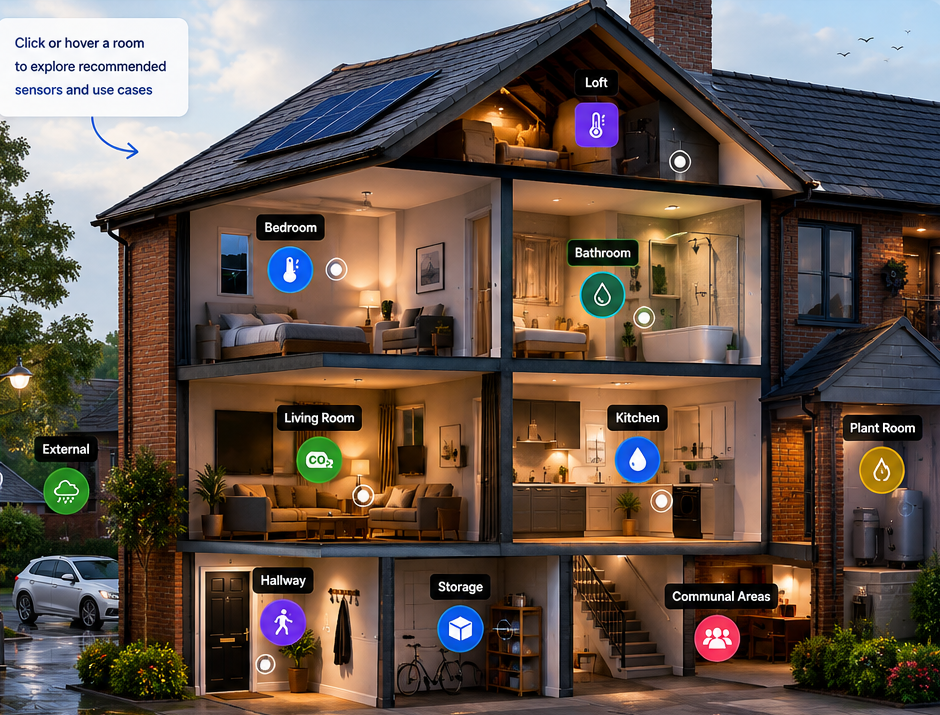
Sensor Knowledge Centre
The catalogue below covers environmental, safety, building fabric, utility, resident signalling, asset and contextual sensors. In practice, the best deployments start with a clear problem statement and the smallest sensor set that answers the operational question.
Showing all sensor profiles.
Temperature
Useful for: Excess cold and heat, heating performance, thermal comfort and post-repair review.
Evidence value: Shows ambient trends over time and can support prioritisation where homes remain persistently cold or hot.
Limitations: Does not prove why the condition exists; heating, fabric, affordability, occupancy and behaviour may all be relevant.
Follow-up: Review trends with repairs history, resident vulnerability and inspection findings.
Relative humidity
Useful for: Condensation and mould-supporting conditions in bedrooms, bathrooms, kitchens and living spaces.
Evidence value: Highlights persistent moisture patterns and helps evidence improvement or recurrence after intervention.
Limitations: Does not prove visible mould, cause or breach on its own.
Follow-up: Combine with temperature, ventilation assessment, resident contact and inspection.
Dew point
Useful for: Condensation risk when air moisture and surface temperatures interact.
Evidence value: More meaningful than humidity alone when assessing condensation risk.
Limitations: Requires accurate temperature and humidity data and correct calculation.
Follow-up: Use as a risk indicator, then inspect likely cold surfaces and ventilation paths.
Surface temperature
Useful for: Cold bridging, insulation issues and surfaces prone to condensation.
Evidence value: Supports survey findings where cold surfaces repeatedly fall below dew point.
Limitations: Not a full fabric diagnosis without competent inspection.
Follow-up: Check insulation, ventilation, heating, thermal bridging and repair history.
CO₂
Useful for: Ventilation effectiveness, stale air patterns and occupancy pressure.
Evidence value: Helps identify where moisture and poor air change may be linked.
Limitations: Should not be used to blame residents or infer exact occupancy.
Follow-up: Assess ventilation, communicate clearly and link to humidity trends.
TVOC
Useful for: Indoor air quality, ventilation pressure and pollutant events.
Evidence value: Supports healthy homes assessment and wider air quality review.
Limitations: Readings vary widely and may need specialist interpretation.
Follow-up: Use with resident reports, ventilation checks and source investigation.
PM2.5
Useful for: Fine particulate exposure, cooking, smoking, external pollution ingress and combustion concerns.
Evidence value: Useful where health, ventilation or indoor pollution concerns are raised.
Limitations: Not a direct damp or mould measure.
Follow-up: Review trends, sources, external conditions and ventilation.
PM10
Useful for: Dust, coarse particulates and environmental air quality changes.
Evidence value: Provides broader air quality context.
Limitations: Can be heavily influenced by activity and external air.
Follow-up: Use as supporting context rather than sole evidence.
Ambient light
Useful for: Lighting, occupation pattern context and some safety/wellbeing signals.
Evidence value: May support HHSRS lighting consideration in specific scenarios.
Limitations: Can be intrusive if misused to infer behaviour.
Follow-up: Use only where purpose is clear and proportionate.
Noise
Useful for: Persistent noise events, nuisance, plant room faults or resident wellbeing signals.
Evidence value: Supports pattern evidence where noise is part of a case.
Limitations: Audio recording raises privacy risks; sound-level monitoring is different from recording speech.
Follow-up: Use sound level only where possible and explain purpose clearly.
Point leak detector
Useful for: Escape of water beneath sinks, baths, boilers and appliances.
Evidence value: Provides early alert and timestamped evidence of water presence.
Limitations: Does not establish cause or extent of damage.
Follow-up: Urgent inspection, repair order, photos and post-repair monitoring.
Leak rope / cable
Useful for: Longer perimeter leak monitoring around plant, baths, walls or risers.
Evidence value: Useful for hidden leak risk and higher-value communal or plant areas.
Limitations: Needs careful installation and maintenance.
Follow-up: Map location and link alert to inspection and repair workflow.
Water flow monitoring
Useful for: Unexpected flow, continuous use or possible leak.
Evidence value: Can detect hidden leaks earlier than visual inspection.
Limitations: May require plumbing integration and careful interpretation.
Follow-up: Investigate anomalies and confirm with inspection.
Water pressure
Useful for: Pressure drops, supply problems, pipe risk and plant performance.
Evidence value: Supports diagnosis in communal systems or managed assets.
Limitations: Not usually needed in simple damp pilots.
Follow-up: Use for plant/communal systems and maintenance regimes.
Flood level
Useful for: Flood risk, basements, communal stores and external inundation.
Evidence value: Creates clear threshold evidence for flood events.
Limitations: Not a substitute for flood risk management.
Follow-up: Escalate to emergency response and asset planning.
Smoke alarm status
Useful for: Fire detection presence, activation and device health where integrated systems permit.
Evidence value: Supports safety assurance and maintenance records.
Limitations: Safety-critical alarms must comply with relevant standards; do not improvise consumer monitoring as statutory fire protection.
Follow-up: Follow fire safety regime and competent-person advice.
Heat detector
Useful for: Heat rise in kitchens, plant rooms and areas unsuitable for smoke detection.
Evidence value: Supports life-safety and fire risk evidence.
Limitations: Must be part of a compliant fire safety approach.
Follow-up: Escalate according to fire safety procedure.
Carbon monoxide
Useful for: Combustion risk from fuel-burning appliances.
Evidence value: Emergency signal requiring immediate action and clear record keeping.
Limitations: Not a general air-quality proxy.
Follow-up: Emergency response, appliance check and resident safety communication.
Natural gas / LPG
Useful for: Potential gas leak or explosive atmosphere risk.
Evidence value: High-priority alert evidence.
Limitations: Requires competent installation and reliable escalation.
Follow-up: Emergency procedure and gas-safe competent response.
Flame sensor
Useful for: Flame detection in specific plant or industrial contexts.
Evidence value: May support specialist safety monitoring.
Limitations: Usually not appropriate for general homes.
Follow-up: Use only within competent-designed systems.
Emergency lighting status
Useful for: Failure or battery health in communal areas.
Evidence value: Supports inspection and maintenance evidence.
Limitations: Not related to damp/mould but relevant to wider safety assurance.
Follow-up: Repair and test under fire/building safety regime.
Door open/closed
Useful for: Access, security, fire door monitoring or vulnerable-resident context.
Evidence value: Can evidence fire door misuse or unusual access patterns.
Limitations: Can become intrusive if used to monitor lifestyle.
Follow-up: Define purpose, consent/notice and escalation route.
Window open/closed
Useful for: Ventilation context, security, excess cold and resident support.
Evidence value: Can explain environmental readings when used proportionately.
Limitations: Risk of blame or surveillance if misused.
Follow-up: Use carefully with clear resident communication.
Vibration / shock
Useful for: Structural movement, impact, vandalism or plant vibration.
Evidence value: Supports event detection and maintenance triage.
Limitations: Does not diagnose structural safety alone.
Follow-up: Competent inspection where structural risk is possible.
Tilt / movement
Useful for: Structural movement, wall movement, retaining structures or temporary works.
Evidence value: Trend data can trigger specialist review.
Limitations: Requires engineering interpretation.
Follow-up: Escalate to structural engineer where thresholds are exceeded.
Crack monitoring
Useful for: Crack width or movement over time.
Evidence value: Can document deterioration and support structural assessment.
Limitations: Needs correct installation and competent interpretation.
Follow-up: Use alongside photographs, surveys and engineering advice.
Roof moisture
Useful for: Ingress, insulation wetting and roof failure risk.
Evidence value: Can highlight hidden defects before internal damage appears.
Limitations: Installation can be specialist and context-dependent.
Follow-up: Inspect roof, drainage, insulation and internal damage.
Electricity consumption
Useful for: Heating use, empty homes, abnormal usage or plant performance.
Evidence value: Supports context around excess cold, affordability and equipment use.
Limitations: Privacy-sensitive and not proof of behaviour or fault.
Follow-up: Use aggregated/proportionate data and explain purpose.
Gas consumption
Useful for: Heating patterns and potential excess cold context.
Evidence value: Useful for fabric/heating performance analysis where lawful and proportionate.
Limitations: May reveal behavioural patterns; needs governance.
Follow-up: Use with consent/notice, vulnerability and heating checks.
Smart meter integration
Useful for: Energy use, temperature correlation and retrofit monitoring.
Evidence value: Supports digital property context if properly governed.
Limitations: Data access and consent can be complex.
Follow-up: Apply DPIA and clear resident communication.
Solar generation
Useful for: Renewable performance and asset assurance.
Evidence value: Supports energy system monitoring.
Limitations: Peripheral to Awaab’s Law unless linked to heating/energy outcomes.
Follow-up: Use for asset and retrofit assurance.
Battery storage status
Useful for: Battery performance, faults and energy resilience.
Evidence value: Supports safety and asset monitoring.
Limitations: Requires specialist safety controls.
Follow-up: Integrate with energy and fire safety procedures.
EV charger status
Useful for: Electrical load, faults and usage of communal/domestic chargers.
Evidence value: Supports asset and electrical safety management.
Limitations: Usually not relevant to damp/mould cases.
Follow-up: Use for wider building safety and asset assurance.
Assistance button
Useful for: Resident concern, welfare need or non-urgent support request.
Evidence value: Creates a timestamped resident signal that can trigger triage.
Limitations: Does not classify the hazard or replace emergency services.
Follow-up: Route to human triage and case note.
Silent help request
Useful for: Discreet resident-initiated contact in supported or vulnerable settings.
Evidence value: Can reveal hidden support needs or unreported property concerns.
Limitations: Safeguarding and emergency boundaries must be clear.
Follow-up: Define escalation, hours of operation and emergency messaging.
QR code reporting
Useful for: Simple reporting from notices, letters or property areas.
Evidence value: Links resident report to property, time and issue type.
Limitations: Depends on smartphone access and digital inclusion.
Follow-up: Offer non-digital alternatives.
NFC tags
Useful for: Tap-to-report or contractor verification at locations.
Evidence value: Useful for inspections, communal checks and resident reporting.
Limitations: Requires compatible devices and process design.
Follow-up: Use for proof-of-visit and structured reporting.
Voice assistant integration
Useful for: Accessible resident reporting and reminders.
Evidence value: May help residents who struggle with forms or apps.
Limitations: Privacy, security and platform dependence must be considered.
Follow-up: Use cautiously with explicit purpose and alternatives.
SMS / WhatsApp reporting
Useful for: Low-friction resident contact and triage.
Evidence value: Creates a conversational evidence trail if integrated into case management.
Limitations: Must not become an unmanaged inbox.
Follow-up: Use structured questions, consent notices and case logging.
Boiler status
Useful for: Heating availability, fault events and runtime.
Evidence value: Supports excess cold and repair triage.
Limitations: May require manufacturer/system integration.
Follow-up: Link to repairs, emergency heating and vulnerability.
Heating runtime
Useful for: Whether heating is operating and for how long.
Evidence value: Helps distinguish equipment failure, control issues and thermal performance.
Limitations: Can be privacy-sensitive and must not be used simplistically.
Follow-up: Review with resident, heating engineer and fabric context.
Ventilation fan monitoring
Useful for: Extractor operation, failure and runtime.
Evidence value: Strong evidence for ventilation-related damp risk.
Limitations: Does not prove resident use or mould cause by itself.
Follow-up: Repair fan, check ducting, airflow and controls.
Filter condition
Useful for: Mechanical ventilation or plant maintenance need.
Evidence value: Supports planned maintenance and air quality assurance.
Limitations: Requires equipment-specific sensors.
Follow-up: Replace filters and record action.
Pump / plant status
Useful for: Plant room failure, sump pump status or communal system faults.
Evidence value: Early warning for water damage, heating outage or service failure.
Limitations: May need BMS integration.
Follow-up: Escalate to maintenance and incident workflow.
Lift monitoring
Useful for: Lift availability, faults and entrapment risk.
Evidence value: Supports service assurance and vulnerable resident access planning.
Limitations: Specialist lift systems and safety regimes apply.
Follow-up: Integrate with lift contractor and resident communication.
External temperature
Useful for: Weather context for excess cold/heat and condensation risk.
Evidence value: Helps interpret internal readings and heating demand.
Limitations: Not property-specific.
Follow-up: Use postcode-level weather cautiously.
Rainfall
Useful for: Ingress risk, roof/gutter issues and repeat damp correlation.
Evidence value: Useful when internal damp follows rain events.
Limitations: Correlation is not causation.
Follow-up: Inspect fabric, gutters, drains and roof.
Wind speed/direction
Useful for: Driving rain, ventilation, heat loss and external exposure.
Evidence value: Supports building-fabric investigation.
Limitations: External data may be approximate.
Follow-up: Use with site exposure and survey findings.
Weather API integration
Useful for: Adds external context to internal sensor trends.
Evidence value: Improves interpretation and supports repeat-pattern analysis.
Limitations: Depends on data quality and location granularity.
Follow-up: Use as supporting evidence only.
Gateway health
Useful for: Connectivity, battery, signal strength and data gaps.
Evidence value: Proves whether the monitoring system was functioning during relied-upon periods.
Limitations: Does not evidence property condition.
Follow-up: Monitor uptime and mark evidence gaps.
Asset tracker / BLE beacon
Useful for: Location of equipment, temporary heaters, dehumidifiers or contractor assets.
Evidence value: Supports operational control and proof of deployment.
Limitations: Can become intrusive if used on people.
Follow-up: Use for assets, not covert personal tracking.
Sensor selection by problem
Start with the operational problem, not the device. Select a problem below to see a sensible starter sensor set and the evidence questions it can support.
Digital Evidence Framework
The strongest evidence model brings together human reports, professional inspection and connected data. Sensor data is usually supporting evidence. It becomes more useful when it is timestamped, contextualised and linked to the action taken.
Evidence hierarchy
| Evidence type | Typical strength | Use | Risk if missing |
|---|---|---|---|
| Resident report | Very high | Starts the duty pathway and captures lived experience. | Hazards may be missed or dismissed. |
| Inspection findings | Very high | Professional assessment, diagnosis and action planning. | Weak defensibility and poor repair specification. |
| Photographs/video | High | Visual record of condition, severity and completion. | Disputes over condition and action taken. |
| Sensor trends | Medium/high | Time-based context, early warning and post-repair review. | Limited ability to evidence recurring or hidden conditions. |
| Repairs history | High | Repeat-case identification and contractor accountability. | Recurring failures appear as isolated jobs. |
| Vulnerability data | High | Priority, communication and risk escalation. | Response may be technically correct but unsafe for the person. |
| Weather data | Supporting | Context for rainfall, cold periods and external exposure. | Missed pattern analysis. |
| AI prediction | Supporting | Prioritisation and hypothesis generation. | Risk of opaque or over-trusted decisions. |
Interactive evidence completeness builder
Use this as a practical case-file prompt. It does not determine compliance, but it helps identify whether a case has the core evidence needed for good operational assurance.
Sensor fusion: why one reading rarely tells the full story
Individual readings can mislead. A strong digital evidence model looks for patterns across multiple signals.
Risk deserves human review because environmental, property, weather, repairs and vulnerability signals are aligned.
Sensor fusion should not produce automated enforcement decisions. It should support triage, evidence gathering and professional assessment.
Vulnerability overlay: the same reading can mean a different priority
A humidity trend does not exist in isolation. The household context matters. A property with a child under five, respiratory illness, disability, older residents or repeated repair history may need different prioritisation from an otherwise similar property.
Property A
Humidity 78%, no known vulnerabilities, first report, no repeat history.
Likely response:Review trend, contact resident and inspect according to triage rules.
Property B
Humidity 78%, child with asthma, previous mould repair, recent complaint.
Likely response:Higher priority review, clear written update, inspection and escalation if risk is confirmed.
Connectivity and technology landscape
Connectivity choices matter because they affect cost, battery life, coverage, data frequency, resident setup and operational reliability.
| Technology | Best fit | Strengths | Watch points |
|---|---|---|---|
| LoRaWAN | Low-power sensors across blocks, schemes or estates. | Long battery life, low data cost, good for simple readings. | Gateway planning, coverage testing and operational ownership. |
| NB-IoT / LTE-M | Wide-area cellular sensors without local gateways. | Useful where installing gateways is difficult. | Coverage, SIM management and recurring connectivity costs. |
| Wi-Fi | Powered devices or homes with reliable resident broadband. | Familiar and high bandwidth. | Resident router dependence, credentials and support overhead. |
| Bluetooth LE | Short-range sensors, beacons and asset tracking. | Low power and inexpensive. | Needs nearby hub/phone/gateway for backhaul. |
| Zigbee / Thread / Matter | Smart-home style local networks. | Growing ecosystem and device variety. | Interoperability, support and estate-scale management. |
| Wired / BMS | Plant rooms, communal blocks and safety-critical systems. | Reliable, suitable for high-value assets. | Installation cost and specialist integration. |
Digital Property Maturity Assessment
This tool is designed to help housing teams discuss their digital evidence capability. It is deliberately focused on operating model maturity, not the number of devices installed.
Governance questions before deploying sensors
- Has a Data Protection Impact Assessment been completed where required?
- Are residents told what is measured, why, how long it is kept and who can see it?
- Is the organisation collecting the minimum data needed for safety and evidence?
- Are thresholds technically defensible and operationally achievable?
- What happens when a device is offline, a battery fails or a gateway loses connection?
- Can alerts be linked to repairs, inspections, complaints, vulnerability and case closure?
- Who is accountable for closing an alert, and what proves it was reviewed?
- How are residents able to challenge, understand or discuss sensor-derived conclusions?
- How does the board know whether monitoring is improving outcomes rather than adding noise?
Legal commentary has highlighted both the potential of sensors and the importance of data protection, tenant communication and secure handling of sensor data. Birketts: environmental sensors and landlord obligations The ICO also provides guidance on Data Protection Impact Assessments for higher-risk processing. ICO: DPIAs
Responsible IoT pilot model
- Define the safety problem. Silent damp risk, repeat mould, excess cold, ventilation, post-repair monitoring, vulnerable resident support or Phase 2 hazard readiness.
- Select the minimum viable sensor set. Do not deploy sensors because they are interesting; deploy them because they answer an operational question.
- Agree thresholds and workflow. A threshold is only useful if it triggers the right action by the right team within an agreed time.
- Inform residents properly. Use plain English, accessible formats, clear purpose, retention rules and routes for questions.
- Connect the data. Link alerts to repairs, inspections, complaints, resident communication, vulnerability and case closure.
- Measure outcomes. Track earlier identification, reduced repeat cases, stronger evidence, resident satisfaction and board assurance.
- Decide what to stop. If a sensor does not improve action, evidence or safety, remove it.
LOTI’s Warmer Homes London project is a useful example because it links sensor scaling with damp and mould risk, retrofit performance and data standards rather than treating devices as standalone gadgets. LOTI: Warmer Homes London IoT Sensor Project LOTI: Damp and mould IoT in social housing
Frequently asked questions
Can sensors prove Awaab’s Law compliance?
No. Sensors can support evidence, prioritisation and assurance, but compliance depends on proper reporting, investigation, action, communication and records.
Should every home have sensors?
Not necessarily. Universal deployment may be appropriate for some providers, but many organisations should start with targeted pilots: repeat damp cases, vulnerable households, known high-risk archetypes or post-repair monitoring.
Can sensor data be used against residents?
It should not be used simplistically or punitively. Environmental data needs context and should support constructive engagement, not blame.
What is the best first sensor set for damp and mould?
Usually temperature, relative humidity and CO₂, with leak detection where water ingress is suspected. Dew point or mould-risk scoring can be derived from temperature and humidity.
What is the biggest risk with IoT programmes?
Collecting alerts without an operational response model. An unmanaged sensor dashboard can create false confidence and additional risk.
Sources and further reading
- GOV.UK: Awaab’s Law timeframes for repairs in the social rented sector
Official phased duties, timescales and environmental monitoring comments.
- GOV.UK: Understanding and addressing the health risks of damp and mould
Government guidance on damp and mould health risks and provider responsibilities.
- GOV.UK: HHSRS operating guidance
Official hazard assessment context for wider housing health and safety risks.
- LOTI: Warmer Homes London IoT Sensor Project
Pan-London sensor programme for damp/mould risk and retrofit evidence.
- LOTI: Damp and mould IoT in social housing
Lessons from London sensor work.
- IoT Solutions Group: Kingston Council proactive damp and mould case study
Council case study using sensors to identify cold and potential mould.
- ICO: Data Protection Impact Assessments
Official UK data protection guidance for higher-risk processing.
- Birketts: Will environmental sensors help social housing landlords?
Legal view on sensors, data protection and risk.
- MHCLG Digital: Data standard to support Awaab’s Law
Government digital blog on housing data standards.
- HACT: UK Housing Data Standards — Awaab’s Law use case
Structured data model work to support implementation.